
“We are standing in the cargo hold – a dim space filled with the scent of wood and the sea. This time, however, the ship is not loaded with alcohol, as it was during Prohibition when the vessel was confiscated by the Finnish state.”
The colourful story of the historic Jan Mayen schooner
A three-masted schooner built in 1914
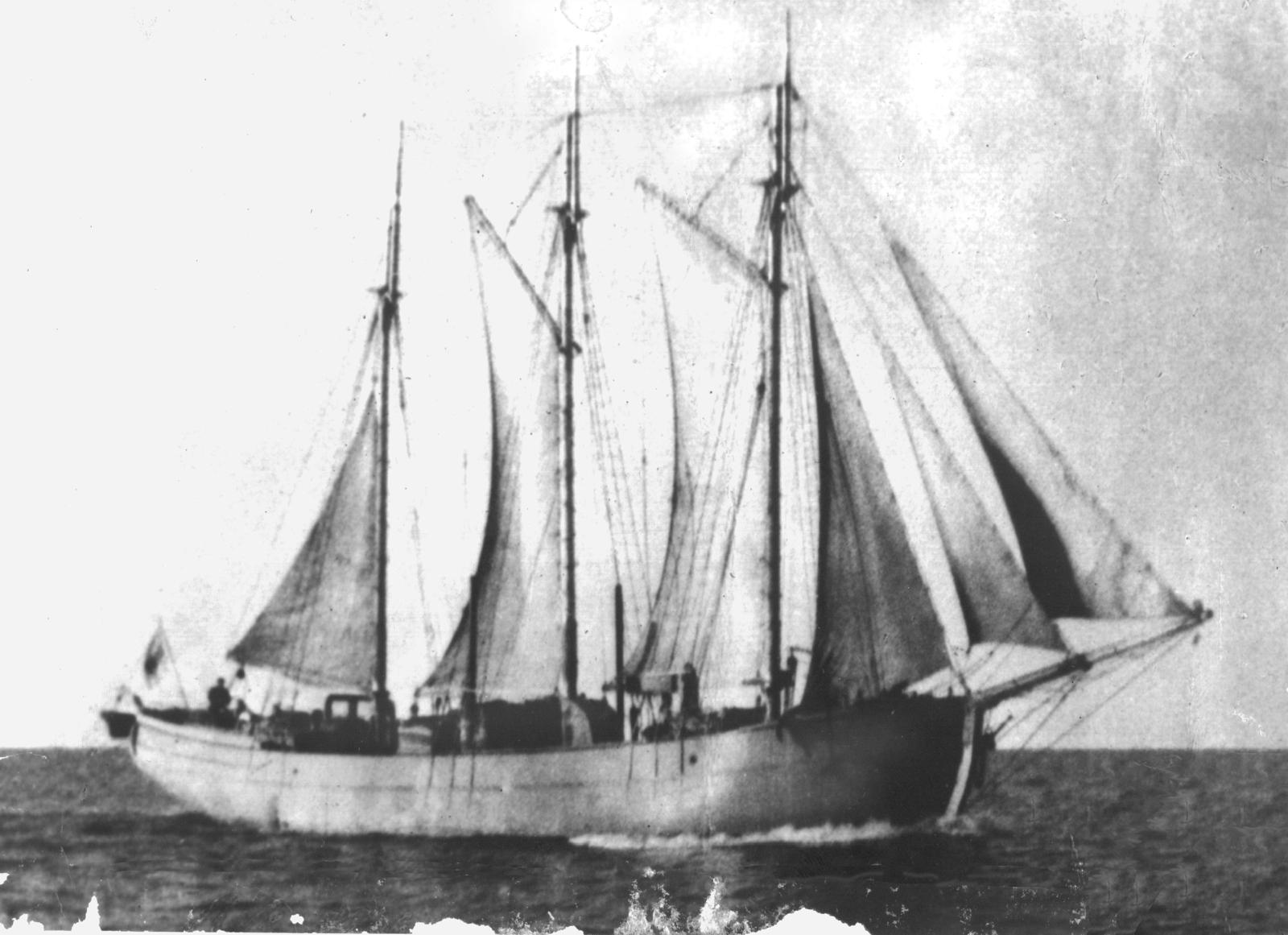
Jan Mayen was originally a 28-metre, three-masted schooner built from oak in Frederikshavn, Denmark, in 1914.
Three-masted Marstal schooners were once a common sight in the Baltic Sea and North Sea. Today, Jan Mayen is the only one of her kind in Finland, and there are believed to be no more than three similar schooners left in Denmark.
Jan Mayen has sailed under the Finnish flag for almost a century. Her long history includes numerous names, owners and purposes – as well as a few stories that would be difficult to make any better.


Today, Jan Mayen is the only one of her kind in Finland, and there are believed to be no more than three left in Denmark.
Jan Mayen has sailed under the Finnish flag for almost 100 years.
A smuggling vessel is caught during Prohibition
SMUGGLING
The ship’s original name was Maria Magdalena, although she sailed under several different names over the years.
Under the name Magdalena, the vessel was confiscated in 1928 near Vänö, south of Nagu. Following the seizure, the ship became the property of the Finnish state.
According to the confiscation report, the cargo included:
- 5,205 ten-litre canisters containing a total of 52,050 litres of spirits
- 229 bottles of cognac
- 129 bottles of whisky
- 129 bottles of liqueur
- 668 bottles of wine.
In other words, this was not exactly a small shipment of holiday souvenirs.


The many names of Maria Magdalena
Vouchers, alcohol exporters and changing names
According to Magdalena’s captain, Leopold Truberg, men had boarded the ship from a motorboat while the vessel was in international waters. The men reportedly presented vouchers entitling them to collect the cargo.
The vouchers had been signed by an agent representing Holm, a German alcohol export company. Magdalena’s captain was also on Holm’s payroll. Several export companies of this kind operated from free ports around the North Sea and Baltic Sea.
The ship also sailed under the name Venus. The famous Finnish smuggler Algot Niska owned a schooner with the same name, and it is possible that this was the same vessel.
After Venus, the ship was known as Psara before being renamed Magdalena. The vessel’s name and nationality were repeatedly changed because of international agreements intended to prevent smuggling. The ship was used for smuggling from at least 1925 onwards.
From smuggling vessel to mobile coastguard station
After being confiscated, the ship was given a considerably more law-abiding role. During the 1930s and 1940s, she served as a mobile coastguard station under the designation LA 2.
The vessel later operated as a Finnish Border Guard patrol ship under the designation MP 1 until 1956.
While in coastguard service, the ship remained largely in her original form. Under her next owners, however, both her appearance and destination would change once again.
Jan Mayen heads north to fish in the Arctic Ocean
New owners and a new name
The ship’s next owner was the Raisio-based company Jäämerenkalastus Oy – Ishavsfiske Ab. The company was founded by brothers Allan and Gunnar Lehtonen from Turku, both of whom were sea captains. Allan Lehtonen was also a seasoned veteran of voyages to Iceland.
The brothers bought the ship from the Finnish Coast Guard in 1957. Before the journey to the Arctic Ocean, the cabins in the cargo hold were removed, and the ship was fitted with a wheelhouse and a small galley on deck.
New masts were acquired, and the vessel was rigged as a schooner once again. As sailcloth was in short supply, the sails were sewn from the sails of an old frigate.
At this point, the vessel received her current name, Jan Mayen, as well as the identification SUOMI 99.

Named after an Arctic island
The Norwegian island of Jan Mayen in the Arctic Ocean is believed to have inspired the brothers from Turku when naming their vessel.
Jan Mayen is a mountainous island with an Arctic, windy and foggy climate. It was once an important base for whalers, and the surrounding waters were known for their plentiful fish stocks.
It was therefore a fitting name for a ship whose next destination lay far to the north.
The journey towards the Arctic Ocean begins
Jan Mayen departed from Turku in 1958, bound for the Arctic Ocean.
The ship stopped in Copenhagen to replenish her provisions. During the port call, one member of the crew went ashore – and never returned to the vessel.
Of the ten-person crew, only four were experienced seafarers. The rest were making their first voyage. At the time, recruiting fishermen experienced in Icelandic waters in Finland was difficult, as there was plenty of work available in less demanding occupations.
Despite being short-handed, the crew decided to continue the voyage.
A storm, icebergs and a lost rudder
Jan Mayen sailed from Copenhagen to the waters around the Faroe Islands, where the crew caught 200 barrels of herring. The journey then continued via Iceland towards the island of Jan Mayen.
The weather became stormy, and the ship drifted far towards Greenland, surrounded by pack ice and icebergs. Fishing in these conditions was difficult, and the crew caught very little.
On the return journey, east of Jan Mayen, something even more serious happened: the vessel lost her rudder. Its bolts had broken under strain, causing the entire rudder to sink into the depths.
The crew now faced a journey of approximately 600 nautical miles back to the Faroe Islands – without a rudder.
Back to the Faroe Islands with an emergency rudder
The crew built an emergency rudder from a cargo boom and the cargo-hold hatch covers. An anchor chain was attached to the bottom edge of the rudder blade to provide weight, and the rudder stock was fitted through a hole drilled in the transom.
With this improvised equipment, Jan Mayen began the slow journey back towards the Faroe Islands.
Along the way, a British trawler offered to tow the vessel. The offer was declined, however, as accepting assistance was considered an insult to the crew’s honour as seafarers. They continued under their own power.
Near the Faroe Islands, a strong current nearly pushed the ship ashore, but the crew managed to control the vessel using her sails.
When Jan Mayen finally reached a fishing harbour, a new steel rudder was installed. The ship underwent an official inspection in Tórshavn and received a seaworthiness certificate for the journey home.
A short career as an ocean-going fishing vessel
The loss of the rudder and the subsequent repairs had a significant effect on the summer’s fishing.
The total catch amounted to only 300 barrels, or approximately 27,000 kilograms of herring. Jan Mayen’s career as an ocean-going fishing vessel therefore ended after this first and only voyage.
The schooner returned to carrying cargo – and soon received yet another new role.
A cargo ship under Elmar Tillander
From Raisio, Jan Mayen passed into the ownership of Elmar Tillander, a shipmaster from Sipoo, who kept her for ten years.
In Sipoo, the vessel was rigged as a galeas. A former Oregon pine mast from the barque Oman was shortened and installed as the mainmast. The galley disappeared from the deck, while the cargo hatches were enlarged and their coamings renewed.
Jan Mayen was well suited to carrying cargo. The post-war period was an era of intense reconstruction, and during the 1960s, Tillander and his sons transported timber from Rauma to Stockholm.
Finnish timber was less expensive than Swedish timber at the time, so demand was high.
When timber exports declined later in the 1960s, Jan Mayen began transporting sand and gravel from Porvoo to Helsinki. Concrete construction was replacing brick construction, and during this period the schooner carried some of the heaviest loads in her history.
From cargo ship to year-round home
Anssi and Ulla Asunta buy Jan Mayen
Anssi and Ulla Asunta bought Jan Mayen in 1969. The following winter, the ship was converted into a home at Kalkkiranta in Sipoo, with the work carried out by Elmar Tillander and his son Rainer.
Central heating was installed, and a galley was once again built on deck. The mess at the stern was converted into a bathroom with a small wood-heated sauna.
The mess’s original decorative mahogany interior was preserved even though the room was given a new purpose.
Restoration was not a common consideration at the time. The ship was simply adapted to meet the needs of the day.
A new home port in Helsinki
In spring 1970, the Asuntas brought Jan Mayen to Helsinki. The ship was initially moored in Lauttasaari and later that year moved to Halkolaituri, also known as T-laituri, on Pohjoisranta.
During the first few years, Jan Mayen was the couple’s only home.
In spring 1974, all vessels were ordered to leave T-laituri. By the following Christmas, Jan Mayen had found a new home port in Tykistölahti at Suomenlinna, where she spent many winters alongside three other galeases.
Summers at sea and winters aboard
During the winter, the Asuntas spent weekends, holidays and festive occasions aboard Jan Mayen. In summer, the schooner sailed around the Archipelago Sea and Åland.
Their voyages also took them to Stockholm and Gotland. Measured in nautical miles, the longest journey was from Helsinki to Lake Saimaa and Lake Puruvesi.
Jan Mayen remained in the ownership of Anssi and Ulla Asunta for a total of 35 years. Throughout that period, they kept the ship warm and dry all year round.
Caring for the schooner throughout the year
Jan Mayen’s hull was treated annually with a mixture of tar and boiled linseed oil.
Every spring, before the ice melted, Anssi Asunta treated the vessel while standing on the ice beside her. Black pigment was added to the treatment used on the hull planking to give the vessel her completely black appearance.
Thanks to decades of dedicated care, the historic schooner built in 1914 continues her story today – now as a boat bar, sauna and unique meeting place at Halkolaituri in Helsinki.